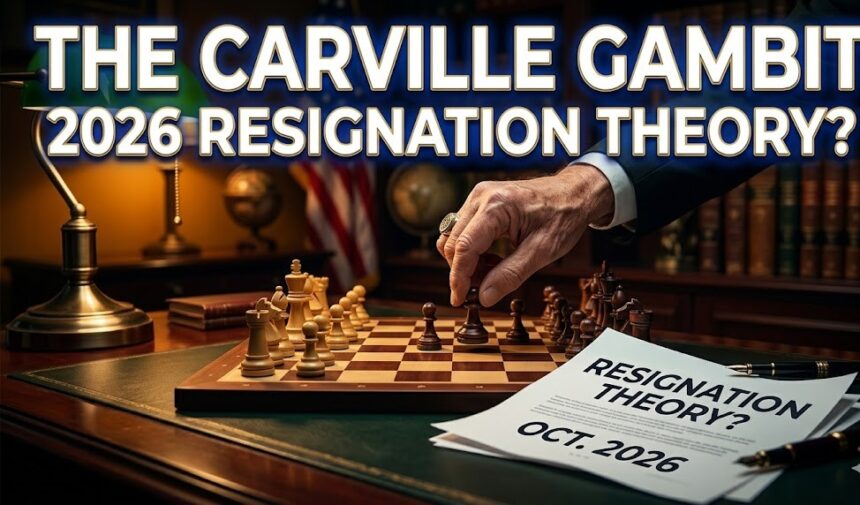

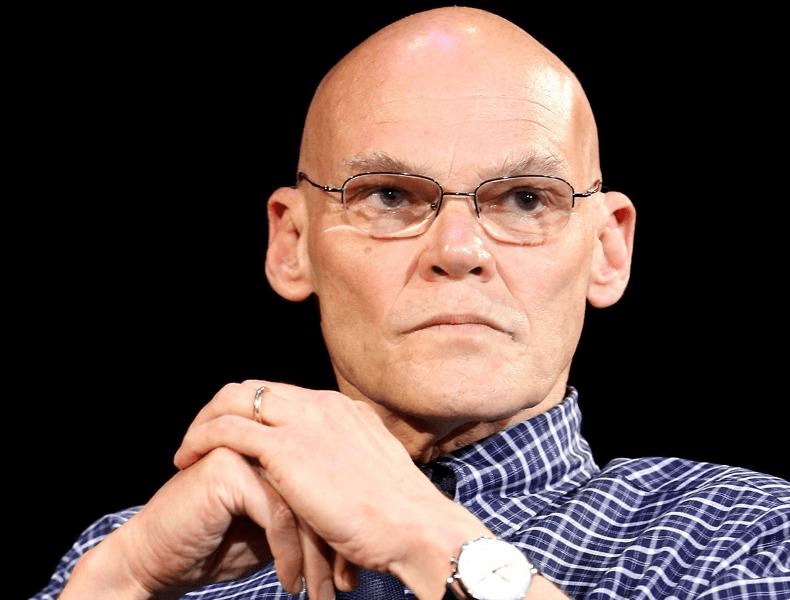
It is March 28, 2026, and the political mercury in Washington is rising toward a fever pitch. With the 2026 Midterm Elections looming like a shadow over the second Trump administration, veteran Democratic strategist James Carville has dropped a rhetorical bomb: the theory that Donald Trump will “chicken out” and resign if the GOP loses its grip on Congress.
In Carville’s world, power isn’t just about the seat in the Oval Office; it’s about the “ebb.” If the Senate and House flip in November, the strategist argues we are looking at a lame-duck presidency on a molecular level—where the guest lists at cocktail parties change and foreign leaders, including the newly seated leadership in Germany, start taking 72 hours to return a call.
The Political Physics of the “Ebb”
Carville’s argument hinges on the concept of political capital as a decaying isotope. In political science, we can model a President’s functional power ($P_f$) as a product of Congressional alignment ($C_a$) and public sentiment ($S_p$):
$$P_f \approx C_a \times S_p$$
If $C_a$ drops to zero (a split or opposition-controlled Congress), the executive’s ability to drive policy through the Federal Budget process evaporates. Carville posits that for a figure like Trump, who thrives on the “optics of winning,” the reality of a hostile Congress—investigations, stalled appointments, and a “looming Christmas party” where he is no longer the center of the universe—will be a psychological deterrent he isn’t “tough enough” to endure.
The “JD Vance” Pardon Play
The most provocative part of the Carville theory is the “Pardon Exit.” By resigning, Trump would elevate Vice President JD Vance to the presidency.
- The Strategic Exit: A resignation would allow for a pre-negotiated deal where Vance issues a full federal pardon to shield Trump from ongoing or future prosecutions.
- The Ford Precedent: This mirrors the 1974 Nixon-Ford transition, but in a 2026 context, it would be framed as a “necessary move for national healing” (or a blatant power play, depending on which news cycle you inhabit).
- The 2028 Implications: Elevating Vance now would give him an incumbency advantage for the 2028 election cycle, something Trump has already hinted at by calling Vance “probably favored” for the future nomination.
Media Narratives vs. Electoral Reality
While Carville is known for his colorful language—calling the President “fat, lazy, and deteriorating”—the data from FiveThirtyEight’s 2026 Midterm Forecast shows a more nuanced picture.
- The “Check and Balance” Voter: Traditionally, the President’s party loses seats in the midterms.
- Economic Volatility: If the 2026 economy shows signs of a “hard landing,” the “walking away” theory gains traction among strategists who believe Trump would rather resign than oversee a recession.
- The MAGA Base: Carville might be underestimating the base’s desire for Trump to stay in the “fight,” regardless of the legislative gridlock.
According to Fox News Media analysis, the legacy media’s obsession with a Trump resignation serves as a distraction from the Democratic party’s own struggle to find a unifying leader for the 2028 cycle.
Conclusion
Is James Carville’s “Chicken Out” theory a genuine forecast or just high-level political theater designed to demoralize the GOP ahead of November? In the 2026 landscape, where the “Politics War Room” moves at the speed of an AI-generated deepfake, the truth usually lies in the middle. Trump has never been one to “walk away” quietly, but the allure of a JD Vance pardon and a permanent return to Mar-a-Lago might become increasingly attractive if the midterms deliver a “blue wall” in both the House and Senate. One thing is certain: the next eight months will be the ultimate test of stamina for the most polarized administration in modern history.
Also Read : Howie Mandel Clashes with Kelly Ripa Over ‘Backhanded’ Age Compliment