
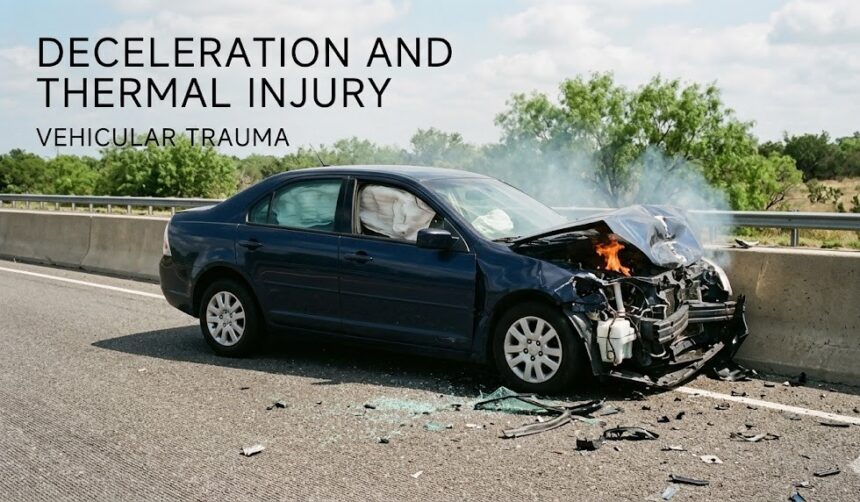

The news of comedian Eugene Mirman’s severe car accident and dramatic rescue from a burning vehicle at a New Hampshire toll plaza is a sobering reminder of human vulnerability. While media reports rightfully focus on the heroic rescue by the State Trooper and Governor Kelly Ayotte, from a clinical and biophysical standpoint, surviving a fiery, high-speed collision is a profound testament to automotive engineering and physiological resilience.
When a patient is transported to a trauma bay with “serious injuries” following a vehicle extraction, medical teams must immediately address two distinct, life-threatening mechanisms of injury: extreme kinetic deceleration and thermal/chemical inhalation. Here is the clinical and mathematical breakdown of what the body endures in this scenario.

The Thermodynamics of Deceleration Trauma
The primary mechanism of injury in a single-vehicle crash into a stationary object (like a concrete toll plaza) is massive kinetic energy transfer. The human body in motion possesses kinetic energy ($KE$), which must be dissipated in a fraction of a second upon impact.
The physics of this energy transfer are dictated by the work-energy theorem. The average force ($F_{avg}$) exerted on the occupant can be modeled as:
$$F_{avg} = \frac{m \cdot v^2}{2d}$$
Where:
- $m$ = The mass of the occupant.
- $v$ = The velocity of the vehicle at the moment of impact.
- $d$ = The crumple distance (how much the front of the car crushes to absorb the impact).
Because velocity is squared ($v^2$), even a minor increase in speed results in an exponential increase in kinetic energy. The vehicle’s crumple zones are engineered to increase the distance ($d$) over which the car stops. By maximizing $d$, the vehicle mathematically reduces the lethal force transferred to the driver’s ribcage, internal organs, and skull. When these limits are exceeded, the patient suffers severe blunt force trauma, frequently resulting in pulmonary contusions, rib fractures, and traumatic brain injuries.
Visualizing Kinetic Energy and G-Force
To truly grasp the violent biophysics of a car crash, we must look at the G-forces exerted on the human body during rapid deceleration. A standard human can withstand a few Gs of force, but instantaneous deceleration can subject the organs to massive gravitational loads, causing them to tear from their ligamentous attachments (e.g., aortic transection).
Use the interactive clinical tool below to model the exact G-force and kinetic energy transfer based on vehicle speed and crumple zone distance.Show me the visualisation
The Biochemical Threat: Carbon Monoxide
While physical burns are a severe risk in a vehicle fire, the most immediate, silent threat to an entrapped occupant is acute carbon monoxide poisoning.
When modern automotive materials burn, they undergo incomplete combustion, releasing massive amounts of carbon monoxide ($CO$). When inhaled, $CO$ crosses the alveolar membrane in the lungs and aggressively attacks the blood’s oxygen transport system. Carbon monoxide binds to the iron atom in the hemoglobin molecule with an affinity roughly 210 to 250 times greater than oxygen ($O_2$).
The competitive binding reaction can be expressed as:
$$HbO_2 + CO \rightleftharpoons HbCO + O_2$$
This rapidly induces systemic cellular hypoxia, leading to a loss of consciousness. This biochemical override is exactly why fast, heroic extractions are the only reason entrapped patients survive to reach a hospital.
Pathophysiology of Thermal Inhalation & Endocrine Response
In addition to toxic gases, inhaling superheated air from a vehicle fire causes immediate damage to the respiratory tract. True thermal inhalation injuries typically occur in the upper airway, as the mucosal lining absorbs the heat. This results in severe, rapid edema (swelling) of the pharynx and larynx. Emergency physicians utilizing Advanced Trauma Life Support (ATLS) protocols will immediately intubate the patient before the airway completely occludes.
Simultaneously, the body’s adrenal medulla dumps massive quantities of catecholamines (epinephrine and norepinephrine) into the bloodstream. This causes aggressive peripheral vasoconstriction, redirecting oxygenated blood exclusively to the brain, heart, and lungs—a brilliant evolutionary adaptation that keeps a patient biologically viable during the critical “Golden Hour” of trauma transport.

Conclusion
Surviving a fiery vehicular collision requires the physics of the vehicle’s crumple zones to adequately dissipate kinetic energy, combined with the rapid intervention of first responders to prevent lethal carboxyhemoglobin saturation. The rescue of Eugene Mirman was a race against the unrelenting mathematics of thermal and kinetic trauma.
Also Read : Who Is Florence Pugh’s Boyfriend? All About Peaky Blinders Actor Finn Cole