

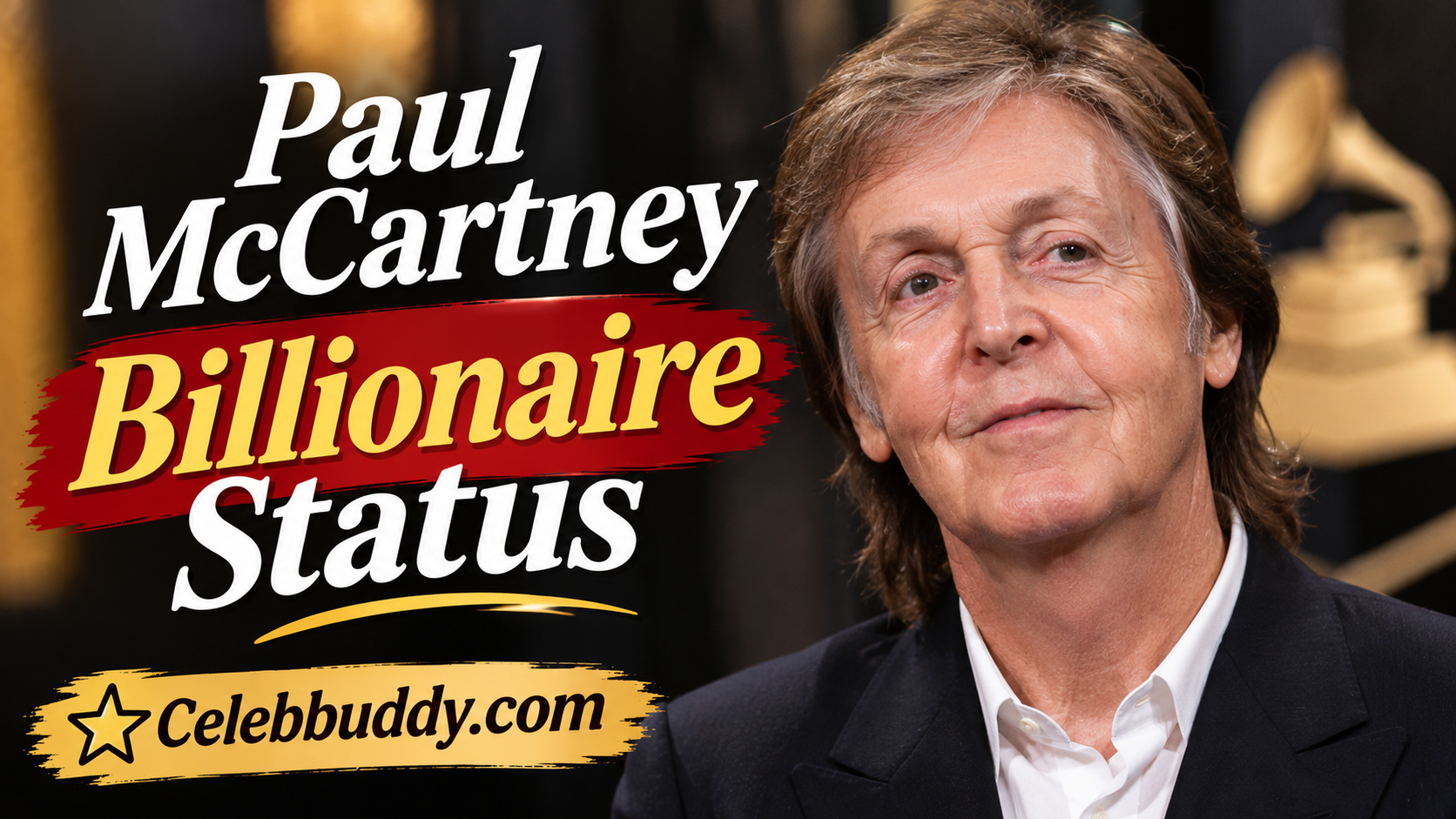
Paul McCartney has joined the ranks of the world’s billionaires. Forbes has valued the former Beatle’s net worth at $1.4bn (£1.04bn), making him the world’s third richest musician behind Jay-Z at $2.8bn (£2.01bn) and Taylor Swift at $2bn (£1.49bn).
The magazine attributed McCartney’s wealth to his musical catalog, legal maneuvers, tours and art collection. The 84-year-old derives the bulk of his fortune from MPL Communications, the publishing company he founded in 1969 that manages his own catalog and those of other artists.

The company’s acquisition of copyrights from artists such as Buddy Holly, as well as Broadway musical scores and Christmas standards such as It’s Beginning to Look a Lot Like Christmas or The Christmas Song (Chestnuts Roasting On An Open Fire), accounts for nearly a quarter of a billion dollars. Every time a high school performs Grease or someone streams the song Blue Suede Shoes, McCartney makes money, according to Forbes.
Additionally, as a former member of the Beatles, McCartney receives 25% of earnings from the band’s Apple Corps holding company, which generates about $50m (£37.2m) annually from streaming residuals and sales of vinyl and merchandise. He also makes around $10m (£7.4m) per year from the band’s songwriting copyrights, a treasure in the music publishing that he fought for in both US and UK courts over the past two decades, and the publication estimates it is worth $200m (£148.8m).
The magazine’s estimates for McCartney’s fortune also include revenue from his touring, most recently 79 shows for his Got Back tour between 2022 and 2025, as well as real estate around the world and paintings from such high-value luminaries as Magritte and Picasso.
McCartney is still an active musician into his 80s, with the release of his most recent album, The Boys of Dungeon Lane, this past May. He appeared as the musical guest for that month’s season finale of Saturday Night Live, and performed the Beatles standard I Want to Hold Your Hand for the first time in 60 years in July as part of fellow billionaire Swift’s star-studded wedding to Travis Kelce at Madison Square Garden.
McCartney was also the subject this year of Man on the Run, a documentary directed by Morgan Neville, about his life after his departure from the Beatles.
An incredible self-own
In 1936, John Scott, son of the late Guardian owner and legendary editor CP Scott, did something unheard of for a media heir: he gave up his stake for the greater good.
After inheriting the newspaper, Scott renounced all financial benefit – bar his salary – in the Guardian (worth £1m at the time and around £62m today) and passed ownership over to the newly formed Scott Trust. The Trust would evolve to have one key mission: to secure the financial and editorial independence of the Guardian in perpetuity.
That means the Guardian can’t be bought. Not by private equity, not by a conglomerate, and definitely not by a billionaire looking for a political mouthpiece. So here are three good reasons to make the choice to support us today.
1. Our quality, investigative journalism is a scrutinising force at a time when the rich and powerful are getting away with more and more.
2. We are independent and have no billionaire owner controlling what we do, so your money directly powers our reporting.
3. It doesn’t cost much, and takes less time than it took to read this message.
But this unique model also means we depend on readers like you from India to help fund our work. If you would rather the news you read was the result of decisions made by journalists and editors, not shareholders or ultra-wealthy tech bros, then, well, you know what to do: Support the Guardian on a monthly basis.
Also Read : Sammy Kershaw Calls Out CMAs After Being Denied Red Carpet Access in a Year Honoring ’90s Country
